
The study of sexuality and lovemaking has fascinated human civilizations for centuries. As early as 1493, Leonardo da Vinci examined the anatomy of sexual intercourse. Later, in the 1930s, anthropologists Margaret Mead and Bronislaw Malinowski began documenting sexual behavior across different cultures. In the 1950s, researchers William Masters and Virginia Johnson conducted groundbreaking clinical studies on the physiology of sexual response.
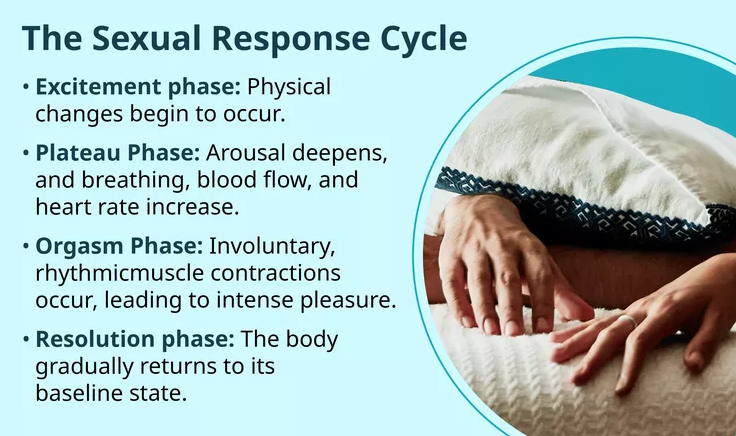
Based on data from 312 men and 382 women, they introduced the concept of the human sexual response cycle, which occurs in four stages: excitement, plateau, orgasm, and resolution.
The Four Stages of Sexual Response
1. Excitement
The excitement phase marks the beginning of sexual arousal. It involves increased blood flow (vasocongestion), a faster heartbeat, and higher blood pressure.
-
In men: The penis becomes erect as blood fills the tissue, and the scrotum tightens and pulls closer to the body.
-
In women: Blood flow increases around the vaginal walls, causing natural lubrication. The clitoris enlarges, and the labia minora swell and darken in color.
Both men and women may also develop a sexual flush, a reddish tint that begins in the upper abdomen and spreads to the chest.
2. Plateau
The plateau stage continues the arousal that began in the excitement phase. Blood pressure and heart rate rise further, and the body builds up tension in preparation for orgasm.
-
In men: The penis becomes fully erect and pre-ejaculate fluid may appear at the tip.
-
In women: The breasts and outer vagina swell, forming an “orgasmic platform.” As orgasm approaches, the labia minora darken even more.
This phase can last from a few seconds to several minutes.
3. Orgasm
Orgasm is the peak of sexual arousal — a brief, intense moment of pleasure followed by a rapid drop in tension.
-
In men: Rhythmic contractions occur in the urethra and pelvic muscles, resulting in ejaculation.
-
In women: The uterus, vagina, and pelvic muscles contract rhythmically every 0.8 seconds.
During orgasm, heart rate, blood pressure, and breathing all spike dramatically.
4. Resolution
In the resolution phase, the body gradually returns to its normal state.
-
In men: The penis loses its erection, the scrotum relaxes, and the testes descend. A refractory period follows, during which men cannot achieve another orgasm.
-
In women: The clitoris and labia return to their normal size and color. Women generally have no refractory period and may experience multiple orgasms within a short time.
The human sexual response cycle shows how intricately the mind and body work together. Masters and Johnson’s research helped destigmatize the study of sexual behavior, transforming it from taboo to scientific exploration.